
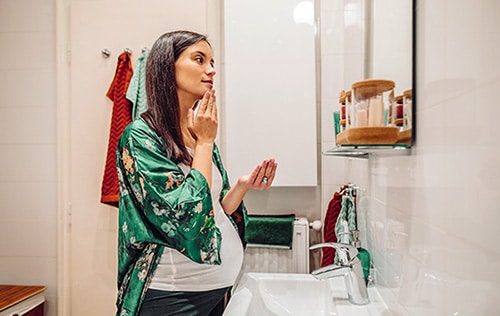
 If your skin has started acting up out of nowhere, you’re not imagining it. Pregnancy skin issues are one of the most common (and most surprising) side effects of pregnancy. Surging hormones, stretching skin, and extra blood flow can all show up on your face and body in ways you never dealt with before pregnancy.
The good news: almost every pregnancy-related skin change is harmless, temporary, and manageable. Below are the seven pregnancy skin issues we hear about most, what’s actually causing them, and what you can safely try for relief.
A quick note: This article is for general information only and isn’t a substitute for medical advice. Always check with your doctor or midwife before starting a new skincare product, medication, or home remedy during pregnancy, and mention any rash or skin change at your next appointment.
- Pregnancy Acne and Breakouts
Even if you’ve never dealt with acne before, inflamed pimples are one of the most common pregnancy skin issues, especially in the first and second trimesters. Rising hormone levels stimulate your oil glands, and that extra oil combines with sweat, dirt, and makeup to clog pores.
What can help:
- An over-the-counter product with salicylic acid (avoid prescription-strength formulas). Salicylic acid is generally considered safe in pregnancy and gently exfoliates without harsh irritation.
- Switching to non-comedogenic, fragrance-free cleansers and moisturizers.
- Always confirm any acne treatment with your doctor before use. Some common acne ingredients (like retinoids) aren’t recommended during pregnancy.
Body acne shows up the same way, just lower down, often on the chest, back, or shoulders. It tends to get worse in hot, humid weather when sweat and oil build up faster. Changing out of sweaty clothes as soon as possible, showering promptly after exercise, and keeping skin dry can help prevent flare-ups.
- Oily Skin
Those same pregnancy hormones tell your oil glands to overproduce sebum, which is what gives your skin that extra shine.
What can help:
- A gentle exfoliating scrub a few times a week.
- Sunscreen formulated for oily skin: look for wording like “oil control,” “dry touch,” or “matte” on the label.
- A mattifying primer under makeup for extra shine control.
- Itchy, Dry Skin (Especially Your Belly)
An itchy abdomen is one of the most frequently asked-about pregnancy skin issues, and it’s almost always harmless. As your belly grows, the skin stretches more tightly, drying it out and triggering that maddening itch.
What can help:
- Resist the urge to scratch: it can irritate skin further and make the itch worse.
- Try an anti-itch lotion such as calamine or an oatmeal-based moisturizer (Aveeno is a popular choice).
- Keep skin well moisturized, especially after showering.
When to call your doctor: Mild, localized belly itching is normal. But if you develop itching all over your body, especially on your palms and soles, and especially without a visible rash, tell your doctor right away. Whole-body itching can occasionally signal a liver-related pregnancy condition that needs monitoring.
- PUPPP (Pruritic Urticarial Papules and Plaques of Pregnancy)
If your stretch marks suddenly develop small, intensely itchy red bumps, you may be dealing with PUPPP, Pruritic Urticarial Papules and Plaques of Pregnancy. It’s a mouthful, but it’s also one of the more well-studied pregnancy skin issues: it affects roughly 1 in 250 pregnancies, most often in the third trimester.
PUPPP typically starts in the stretch marks of the abdomen and can spread to the thighs, buttocks, or arms. Researchers don’t know exactly what causes it, though hormonal changes are the leading theory, and some studies suggest it may be slightly more common in pregnancies carrying a boy. Women with darker skin tones appear to be less likely to develop it.
The reassuring part: PUPPP hasn’t been linked to any long-term risk to you or your baby. It almost always resolves within days to weeks after delivery, and it typically doesn’t return in future pregnancies.
What can help:
- Calamine lotion or a cool, wet compress
- Oatmeal baths
- A fan pointed at the itchy area (especially helpful for sleep)
- Light, breathable cotton clothing
- Keeping your home cool
Show your doctor any new rash. They may prescribe a topical steroid, an antihistamine, or (in more uncomfortable cases) an oral medication to calm the itching. If scratching breaks the skin, your doctor may also recommend an antibiotic to prevent infection.
- Melasma (“Mask of Pregnancy”) and Dark Patches
Dark, uneven patches on the face, often called melasma or the “mask of pregnancy,” are another one of the most visible pregnancy skin issues. They tend to appear around the lips, nose, cheeks, and forehead, and sometimes on the arms or other sun-exposed skin.
Melasma is triggered by hormonal shifts and tends to run in families, so it’s worth asking a mother or sister whether they experienced it too. Women with darker skin tones are more prone to developing it.
What can help:
- Daily broad-spectrum sunscreen: UV exposure can darken melasma, so reapply every couple of hours if you’re outdoors and try to avoid peak sun between 10 a.m. and 2 p.m.
- Skipping tanning beds entirely.
- A gentle, non-irritating cleanser; harsh soaps can worsen discoloration.
- Concealer or foundation to cover patches in the meantime, rather than skin-lightening products, which aren’t considered safe during pregnancy.
- Alpha hydroxy acid (AHA) products can help exfoliate uneven pigment, but check with your doctor before adding any active ingredient to your routine.
The good news: melasma usually fades on its own within a few months after delivery.
- Changes to Skin Tags and Moles
Pregnancy hormones and increased blood flow can cause skin tags to appear for the first time, or existing ones to grow. Moles can behave the same way. New moles may appear, and existing moles may darken or grow slightly larger.
What can help: Most of these changes are a normal part of pregnancy and nothing to worry about. That said, always show your doctor any mole that changes shape, color, size, or texture, or a mole that starts to bleed or itch. The same “when to get a mole checked” rules apply during pregnancy as any other time.
- Under-Eye Bags and Dark Circles
Between a growing belly and, eventually, a very active baby keeping you up at night, quality sleep gets harder to come by, and it shows under your eyes.
What can help:
- A gel eye mask kept in the fridge, applied in the morning to reduce puffiness and constrict blood vessels.
- A brightening under-eye concealer to camouflage dark circles for the day.
- Elevating your head slightly while sleeping can also reduce morning puffiness.
Frequently Asked Questions about Pregnancy Skin Issues
What are the most common pregnancy skin issues?
The most common pregnancy skin issues are acne and body breakouts, oily skin, itchy/dry skin (especially the abdomen), PUPPP (an itchy rash in stretch marks), melasma or dark facial patches, changes to skin tags and moles, and under-eye dark circles. Nearly all of these are hormone-driven and temporary.
Is itchy skin during pregnancy normal?
Mild, localized itching, especially on a stretching belly, is normal and usually caused by dry, tight skin. However, itching that spreads over your whole body, particularly the palms and soles, should be reported to your doctor right away, since it can occasionally point to a condition that needs monitoring.
What is PUPPP and is it dangerous?
PUPPP (Pruritic Urticarial Papules and Plaques of Pregnancy) is an itchy rash that typically develops in third-trimester stretch marks. It affects about 1 in 250 pregnancies. PUPPP is uncomfortable but not dangerous. It hasn’t been linked to any long-term risk to mother or baby, and it usually clears up within a few weeks of delivery.
Will pregnancy dark spots (melasma) go away?
Yes. Melasma, sometimes called the “mask of pregnancy,” is caused by hormonal changes and usually fades within a few months after delivery. Daily sunscreen can help prevent it from getting darker in the meantime.
Are new moles or skin tags during pregnancy normal?
Yes, it’s common for pregnancy hormones to cause new skin tags to form or existing moles to darken and grow slightly. Still, any mole that changes rapidly in size, shape, color, or texture should be checked by a doctor.
Are pregnancy skin issues safe to treat with over-the-counter products?
Many mild pregnancy skin issues can be managed with pregnancy-safe over-the-counter options like calamine lotion, oatmeal baths, and salicylic acid acne treatments, but you should always confirm any new product with your doctor first, since some common skincare ingredients aren’t recommended during pregnancy.
Editor’s Note: This article was originally published on October 11, 2017, and has since been updated.